A MiniMax H3 prompt works best when it reads like a shooting script, not a caption: three labeled fields for picture, sound and music, and every spoken line tied to a numbered speaker. The complaints in the most-shared Reddit thread on MiniMax's official guide (wrong character talking, gibberish lines, cuts nobody asked for) each line up with one piece of that structure left out.
Built on MiniMax's two official MiniMax H3 prompt writing guides.
You want Write this The skeleton integrated_multimodal_description:thenoverall_soundscape:thennon_diegetic_music:A new shot [Shot 2] At 00:04.000, the camera cuts to...(no timestamp on Shot 1)A spoken line The old fisherman (S1) says: <d>[English] Tide's turning.</d>Nobody talking Say so: "her lips stay closed" No background music non_diegetic_music: N/AReady-made prompts 20 MiniMax H3 prompt examples
How a MiniMax H3 prompt is built
MiniMax's hosted service first runs your words through a rewriting step the model card calls H3-Context-IR, "critical to the quality of the final output" and not part of the open weights. Wherever MiniMax H3 runs without it, you write the rewritten form yourself.
Movoa is one of those places: we pass your MiniMax H3 prompt through unchanged, up to 7,000 characters, so type the official format.
| Field | What goes in it | Length |
|---|---|---|
integrated_multimodal_description |
Style, shots, subjects, actions, camera moves, speakers, dialogue, sounds tied to an action | Most of the prompt |
overall_soundscape |
Ambience, footsteps, impacts, breathing, laughter across the clip | 1–4 sentences |
non_diegetic_music |
Score only the audience hears: instruments, tempo, volume | 1–3 sentences, or N/A |
Write all three in English. Only dialogue inside <d> tags and text visible on screen stay in their own language.
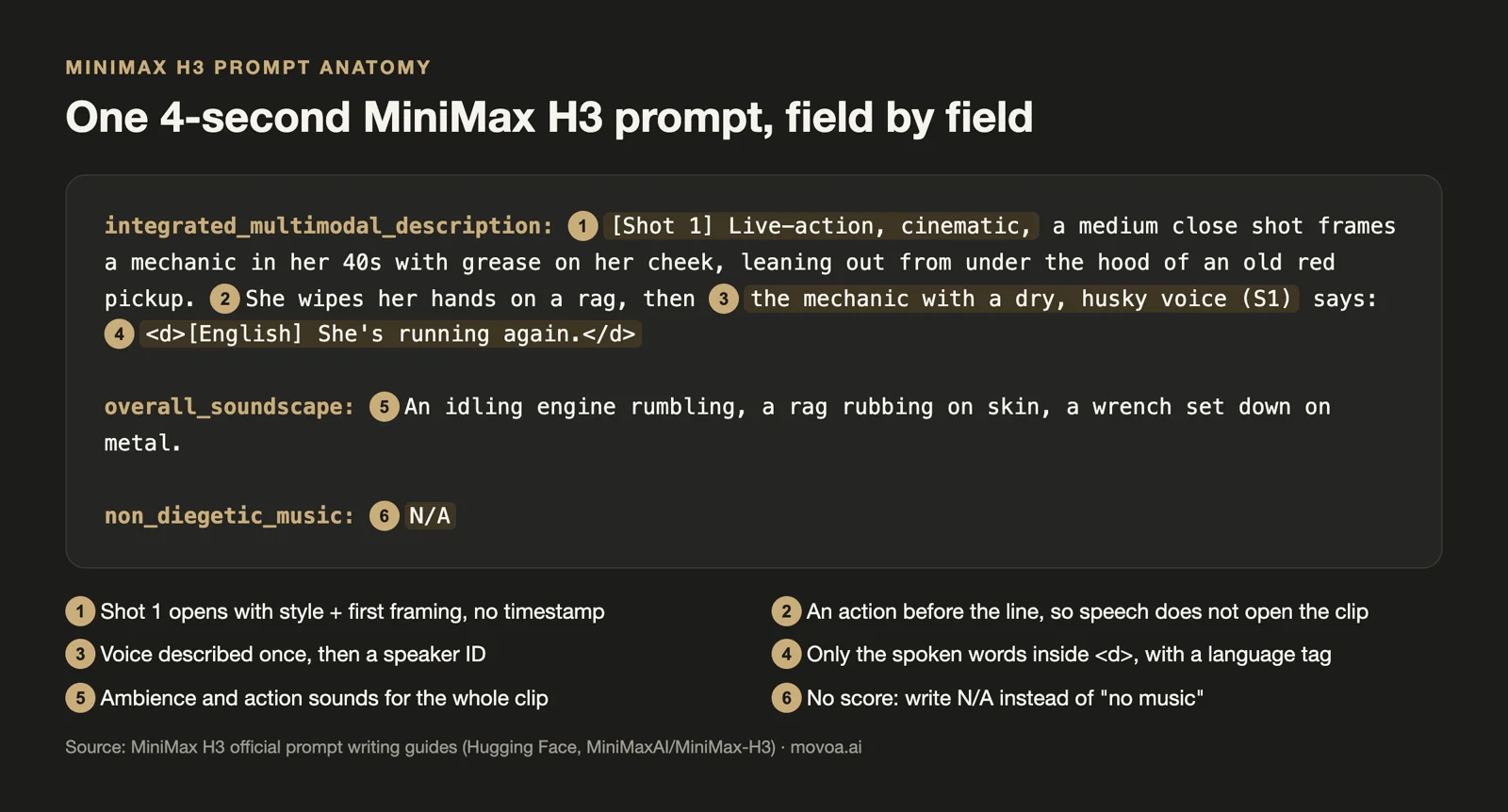
Everything here comes from the base writing guide, the reference-mode guide and MiniMax's prompt-writing skill on GitHub.
MiniMax H3 text-to-video prompt formula
Text to video has no opening instruction. Start at the first field:
integrated_multimodal_description: [Shot 1] <style>, <shot size> frames <subject and setting>. <Action>. The camera <move> as <what changes>. [Shot 2] At 00:0X.000, the camera cuts to <new information>.

overall_soundscape: <ambience>. <sounds caused by the actions>.

non_diegetic_music: <instruments, tempo, volume> | N/A
Four rules from the official guide decide whether MiniMax H3 follows it:
- Open Shot 1 with style and framing. The guide's examples: "Live-action, cinematic", "2D-animated", "3D CG", "claymation", "watercolor", "vintage film".
- Shot 1 gets no timestamp. Later shots start with a strictly increasing cut time in
MM:SS.mmm. - Cut only for new information (place, viewpoint, moment, subject); to get closer, move the camera.
- Fit the timeline to the clip length. The official skill plans for 4 to 15 seconds; Reddit users running the open weights locally report longer and 2K clips.
On Movoa, free clips are 4 seconds at 480p, so write one shot and one action. Paid plans go to 15 seconds at 768p, room for two or three shots. Try a text prompt in the text-to-video generator.
MiniMax H3 image-to-video prompt formula
For image to video, the first line is fixed. Copy it exactly and leave one blank line:
For the target video, at 0.00 seconds into the target video, <Picture 1> (from [Shot 1]) is fully referenced.

integrated_multimodal_description: [Shot 1] <style taken from the photo>, the <subject> shown in <Picture 1> <keeps appearance, clothing, position>. <First movement>. <How it develops>. <Result>.

overall_soundscape: ...

non_diegetic_music: ...
The guide's order: first-frame anchor, action onset, development, result. Restate what the photo shows and that it stays the same.
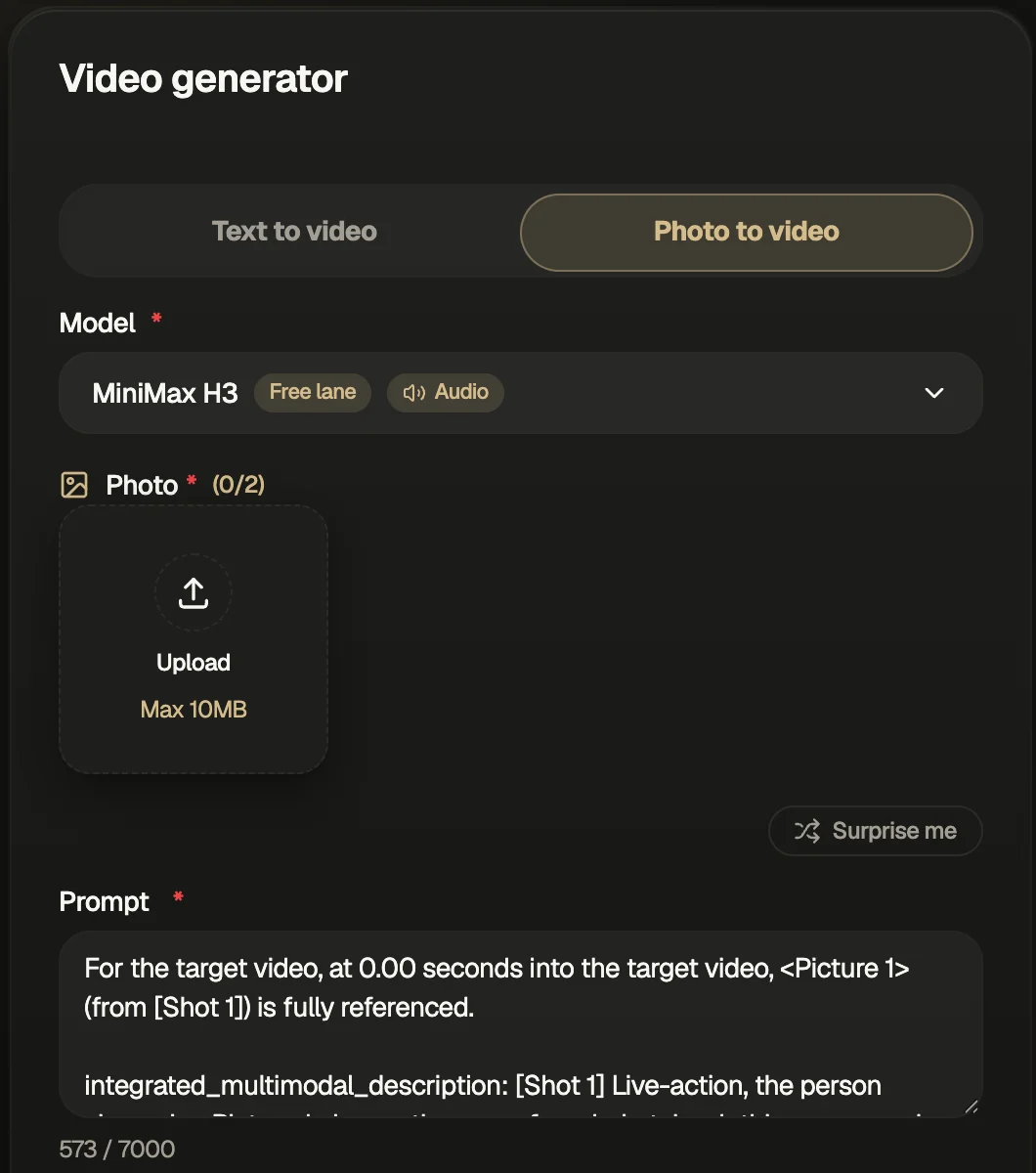
On Movoa, your photo is <Picture 1>, the frame at 0.00 seconds; two photos are placed side by side on one first frame, so describe a left and a right half. The photo to video tool opens with the upload ready.
MiniMax H3 prompts with reference images and keyframes
MiniMax H3 can do more with images than start from them:
| Mode | The image is | Prompt shape |
|---|---|---|
| First and last frame (FL2VA) | The opening and the ending | A fixed alignment line, then the path between them |
| Last frame only (L2VA) | Where the clip must land | A fixed alignment line, then a plausible lead-up |
| Full reference (Ref2VA) | A character, place, style, voice or video to reuse | Six sections: subject_definitions, summary, retention_analysis, detailed_description, overall_soundscape, non_diegetic_music |
Full reference mode labels each asset (<Subject 1>, <Picture 1>, <Video 1>, <Audio 1>) and wants a 350 to 500-word description; one Reddit user puts a good one at 15 to 20 minutes of writing. It also covers editing an existing clip: <Video 1> is the source, and the prompt states what is preserved and what changes.
Movoa runs MiniMax H3 in text-to-video and first-frame image-to-video; the other modes need a multi-asset host such as ComfyUI's H3 reference template.
How to write dialogue in a MiniMax H3 prompt
MiniMax H3 makes speech in the same pass as the picture, so a line goes into the timeline: who speaks, a speaker ID, the words.
The old fisherman with a low, gravelly voice (S1) says: <d>[English] Tide's turning. We go now.</d>
- Speaker IDs. Everyone who speaks or sings gets
(S1),(S2)for the whole clip; silent characters get none; two voices at once are(S1,S2). - Describe the voice once: age, gender, pitch, timbre, pace, accent, on screen or not, so each speaker keeps one stable identity.
- Only spoken words go inside
<d>, after a language tag such as[English]or[Japanese], verbatim. A Spanish line stays in Spanish. - Voiceover uses the exact phrase
says in an off-screen voiceover, followed right after</d>by a note that the character's lips stay completely closed. - A line that crosses a cut gets
<scenetrans>at both joining points and a sentence that the audio continues; a line cut off by the end of the clip gets<cutoff>.
Budget words to seconds: a 4-second free clip fits one line of six to eight words after an opening gesture. Overlong lines get rushed or garbled, one of five complaints in the most-shared Reddit thread on the official guide. More on the audio side: AI video with audio.
Two habits from daily MiniMax H3 users: if characters talk when nobody wrote a line, describe their mouth ("her lips stay closed throughout"). And since a Hugging Face report describes garbled speech in the first half-second of some clips, open with an action before the first <d> line.
Sound effects and music in a MiniMax H3 prompt
MiniMax H3 reads sound from three places:
| Sound | Where it goes in a MiniMax H3 prompt |
|---|---|
| Caused by an on-screen action at one moment | Inside the shot: "The glass hits the floor with a sharp crack." |
| Ambience and repeated physical sounds | overall_soundscape |
| Music a character can hear (radio, busker, singing) | Inside the shot, as an event |
| Score only the audience hears | non_diegetic_music |
| No score / total silence | non_diegetic_music: N/A / overall_soundscape: N/A |
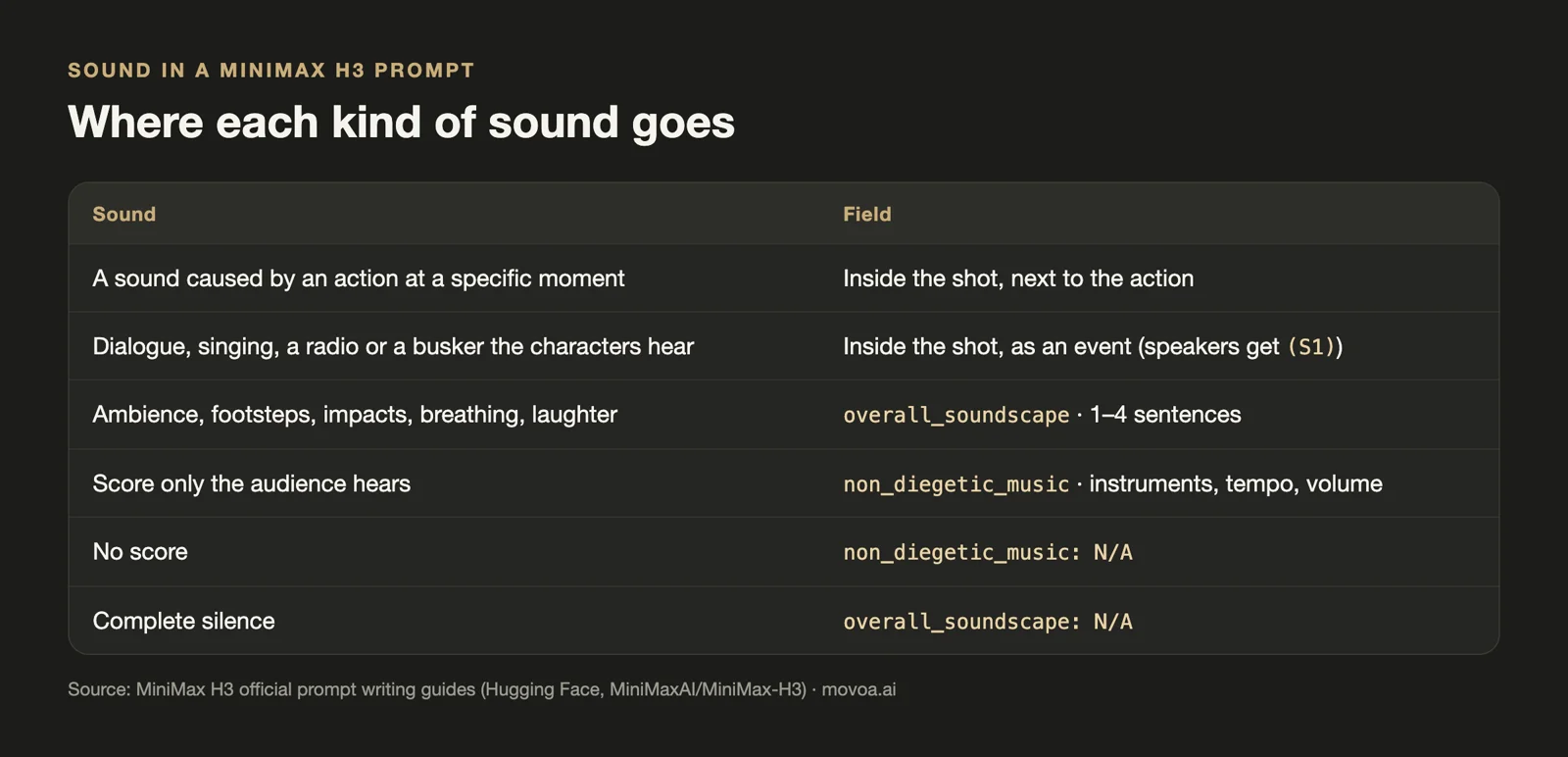
Keep dialogue out of overall_soundscape, and describe music by instruments, tempo and volume, never mood words.
Write what you want to hear, not what to remove: Movoa has no negative-prompt box for MiniMax H3, and ComfyUI notes its default workflow has no negative branch, so "no music" is not subtracted while N/A is. A Hugging Face discussion reports weak ambience in dialogue scenes but strong action-tied sounds.
MiniMax H3 prompt camera movement vocabulary
The base guide writes camera motion as a move, an amplitude and a speed. These are its exact terms:
| Term | What the camera does |
|---|---|
| Zoom In / Zoom Out | Focal length changes, body stays put |
| Push In / Pull Out | Camera moves forward or back |
| Pan Left / Pan Right | Lens turns sideways in place |
| Truck Left / Truck Right | Camera slides sideways |
| Tilt Up / Tilt Down | Lens turns up or down in place |
| Pedestal Up / Pedestal Down | Camera rises or lowers |
| Arc Shot | Circles the subject |
| Tracking Shot | Follows a moving subject |
| Static Shot | Nothing moves |
| Shake Slightly / Shake Strongly | Handheld shake |
| POV | The subject's point of view |
| Roll Clockwise / Counterclockwise | Rotates on the lens axis |
| with small / large amplitude | How far the framing changes |
| at slow / fast speed | How fast it changes |
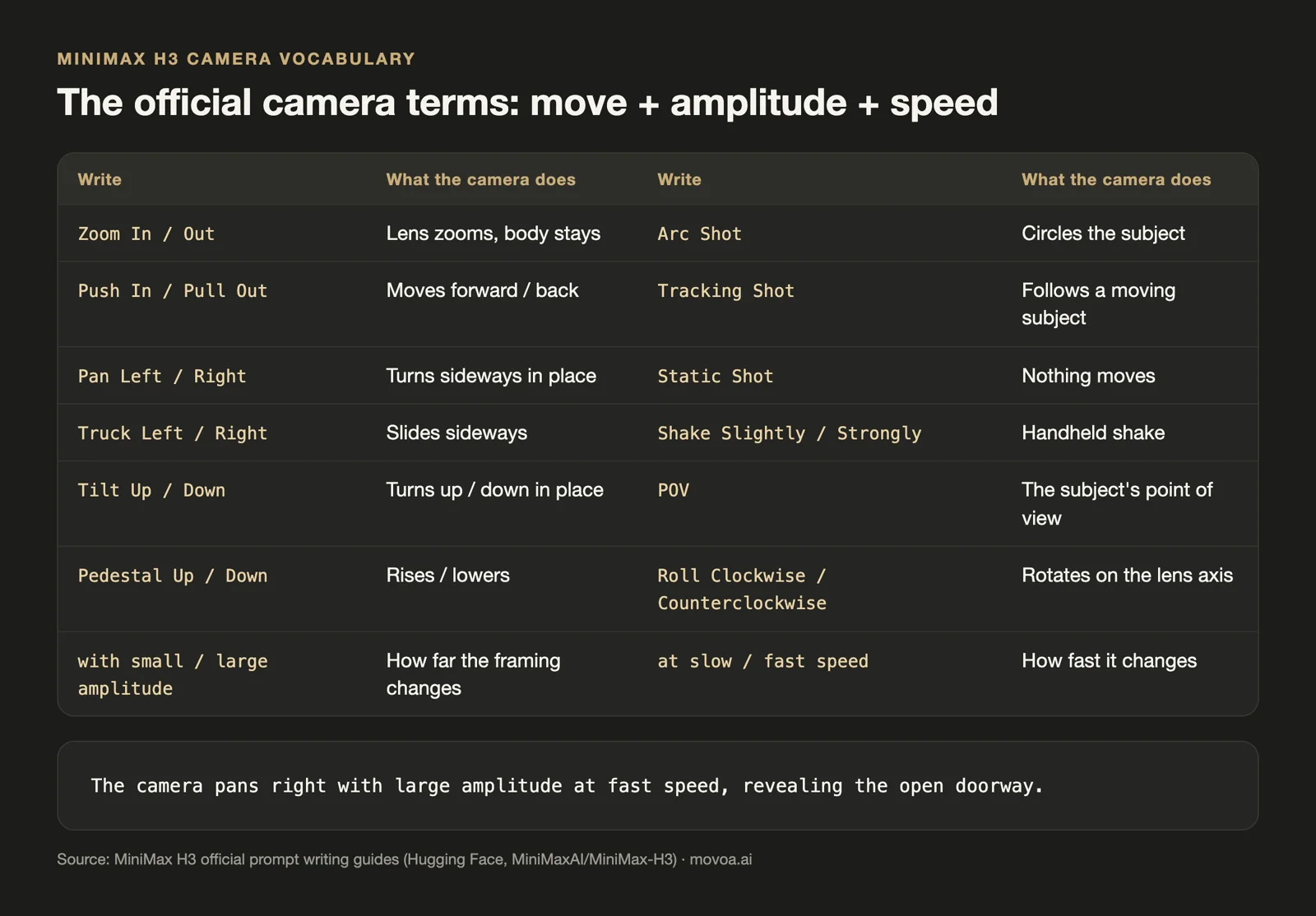
Skip amplitude and speed for medium and normal, and write the move as a sentence tied to what it reveals: "The camera pans right with large amplitude at fast speed, revealing the open doorway." Use one main move per shot.
20 MiniMax H3 prompt examples you can copy
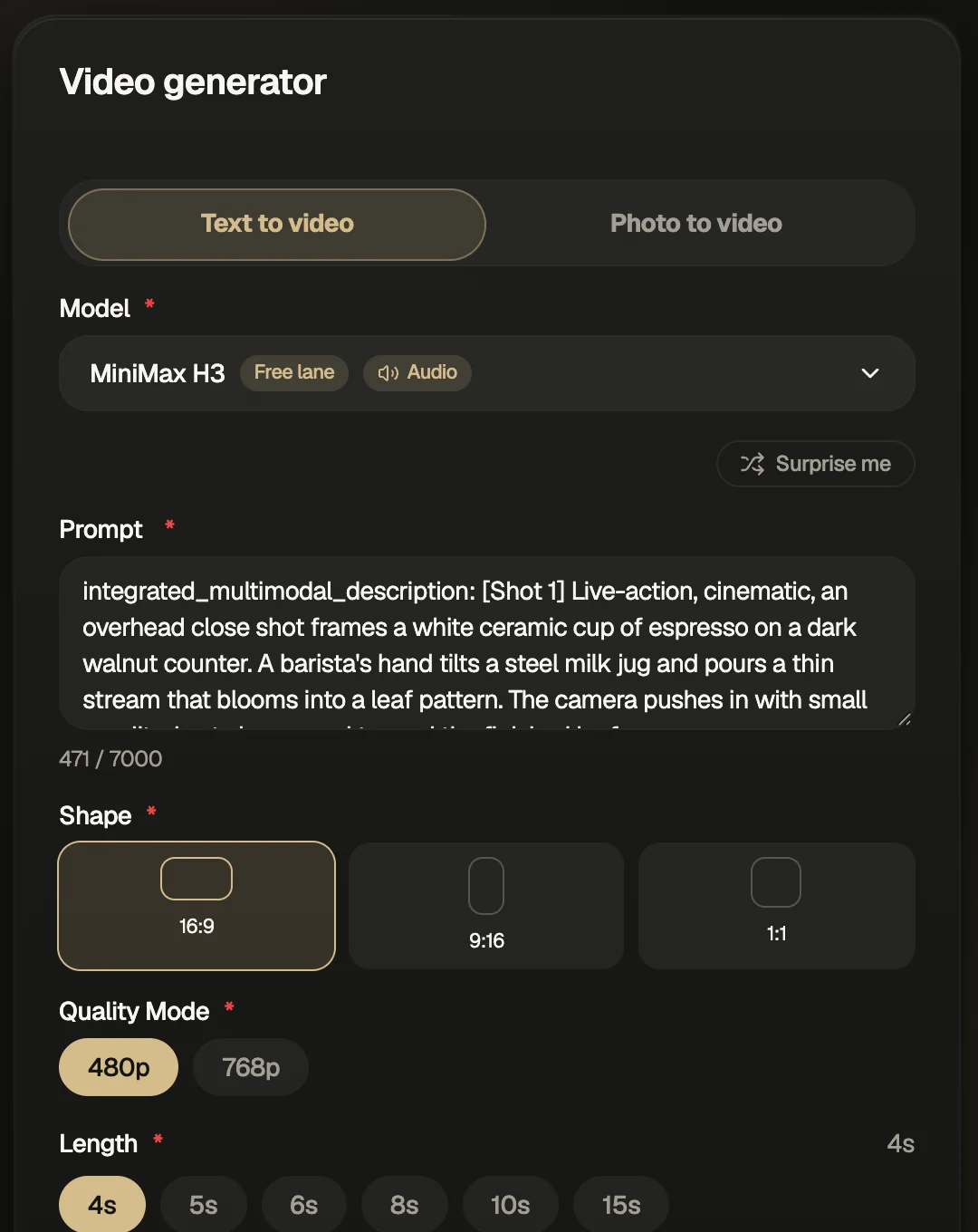
Each MiniMax H3 prompt below follows the official format and fits its length. 4-second ones run free at 480p; 6 to 15 seconds and 768p need a plan. The run link opens Movoa with MiniMax H3 selected and the prompt filled in; set the length before generating.
Short MiniMax H3 prompts for a 4-second clip
1. Latte art pour.
integrated_multimodal_description: [Shot 1] Live-action, cinematic, an overhead close shot frames an espresso cup on a walnut counter. A barista pours steamed milk that blooms into a leaf pattern. The camera pushes in with small amplitude at slow speed.

overall_soundscape: Hissing milk, low café chatter.

non_diegetic_music: N/A
2. Cat versus pen.
integrated_multimodal_description: [Shot 1] Live-action, a medium close shot frames a gray tabby on a cluttered desk beside a blue pen. The cat stares at the camera, then pushes the pen off the edge with one paw. The camera holds a static shot.

overall_soundscape: The pen tapping the floor, one short meow.

non_diegetic_music: N/A
3. Umbrella on a neon street.
integrated_multimodal_description: [Shot 1] Live-action, cinematic, a medium-wide shot frames a woman in a beige trench coat on a rain-soaked street at night, neon in the puddles. She snaps a clear umbrella open above her head. The camera trucks left with small amplitude at slow speed.

overall_soundscape: Steady rain, the snap of the umbrella opening.

non_diegetic_music: Slow synth pads over a soft electronic pulse.
4. Marshmallow catches fire.
integrated_multimodal_description: [Shot 1] Live-action, a close shot frames a marshmallow on a stick over a campfire at dusk. It catches, a small flame wraps around it, and a hand pulls it back and blows it out. The camera holds a static shot.

overall_soundscape: Crackling logs, a soft whoosh, one puff of breath.

non_diegetic_music: N/A
5. Clay snail.
integrated_multimodal_description: [Shot 1] Claymation, a close shot frames an orange clay snail on a green clay leaf with visible thumbprints. It stretches its eye stalks, looks left, and slides forward. The camera holds a static shot.

overall_soundscape: A soft squelch, one bird chirp.

non_diegetic_music: Plucked ukulele at a slow, playful tempo.
MiniMax H3 dialogue prompts
6. One line after an action (4 s, free).
integrated_multimodal_description: [Shot 1] Live-action, cinematic, a medium close shot frames a mechanic in her 40s leaning out from under the hood of an old red pickup. She wipes her hands on a rag, then the mechanic with a dry, husky voice (S1) says: <d>[English] She's running again.</d>

overall_soundscape: An idling engine, a rag on skin, a wrench set down on metal.

non_diegetic_music: N/A
7. Two kids shout together (4 s, free).
integrated_multimodal_description: [Shot 1] Live-action, a wide shot frames two children in yellow raincoats running down a grassy hill after an ice cream van. The two children with high, excited voices (S1,S2) shout together, <d>[English] Wait for us!</d> The camera tracks them at fast speed.

overall_soundscape: Footsteps on wet grass, the van pulling away.

non_diegetic_music: N/A
8. Two-person exchange (8 s).
integrated_multimodal_description: [Shot 1] Live-action, cinematic, a medium two-shot frames an elderly man and a young woman on a park bench. The elderly man with a slow, raspy voice (S1) tosses a crumb to the pigeons and says: <d>[English] They remember who feeds them.</d> The young woman with a light, amused voice (S2) says: <d>[English] Then they'll remember me too.</d> The camera pushes in with small amplitude at slow speed.

overall_soundscape: Pigeons cooing and flapping.

non_diegetic_music: Soft acoustic guitar at a moderate tempo.
9. Voiceover with closed lips (8 s).
integrated_multimodal_description: [Shot 1] Live-action, cinematic, a wide shot frames a woman in a wool coat alone on a train platform at dawn. The camera pushes in with small amplitude at slow speed. The woman with a quiet, low voice (S1) says in an off-screen voiceover: <d>[English] I almost didn't come back.</d> while her lips remain completely closed.

overall_soundscape: Wind on the platform, a distant train horn.

non_diegetic_music: Sparse piano over a low sustained string, slowly growing louder.
10. Question and answer across a cut (10 s).
integrated_multimodal_description: [Shot 1] Live-action, cinematic, a medium shot frames a head chef at the pass of a busy kitchen. The head chef with a calm, deep voice (S1) says: <d>[English] Table six, are they ready?</d> [Shot 2] At 00:05.000, the camera cuts to a young server in a black apron at the kitchen door. The server with a quick, bright voice (S2) says: <d>[English] Ready when you are, chef.</d>

overall_soundscape: Sizzling pans, plates clinking on steel.

non_diegetic_music: N/A
MiniMax H3 prompts built around sound
11. Storm in a cabin (6 s).
integrated_multimodal_description: [Shot 1] Live-action, cinematic, a medium-wide shot frames a wooden cabin lit by one oil lamp, rain streaming down the window. A man in a knit sweater looks up from a book as lightning flashes and the lamp flickers. The camera holds a static shot.

overall_soundscape: Heavy rain on a tin roof, a thunder crack right after the flash.

non_diegetic_music: N/A
12. Street violinist (8 s). Music the characters hear goes in the description.
integrated_multimodal_description: [Shot 1] Live-action, cinematic, a medium shot frames a young violinist in a gray hoodie under a stone arch in an old square at golden hour. She plays a fast, bright folk melody as two passersby stop to watch. The camera arcs left around her with small amplitude at slow speed.

overall_soundscape: Footsteps on cobblestones, a coin dropping into the case.

non_diegetic_music: N/A
13. Silent spacewalk (6 s).
integrated_multimodal_description: [Shot 1] 3D CG, cinematic, a wide shot frames an astronaut beside a space station solar panel, Earth's blue curve below. The astronaut tightens a bolt with a gloved hand. The camera pulls out with large amplitude at slow speed.

overall_soundscape: N/A

non_diegetic_music: N/A
MiniMax H3 camera movement prompts
14. Arc shot around a potter (6 s).
integrated_multimodal_description: [Shot 1] Live-action, cinematic, a medium shot frames a potter shaping a tall clay vase on a spinning wheel in a sunlit studio. The camera arcs right around her with large amplitude at slow speed, ending on her face in profile.

overall_soundscape: The whir of the wheel, wet clay under her fingers.

non_diegetic_music: Warm marimba at a slow tempo.
15. Tracking a cyclist (6 s).
integrated_multimodal_description: [Shot 1] Live-action, cinematic, a medium shot frames a cyclist in a red jersey on a coastal road at sunrise. The camera tracks alongside him at fast speed, then pulls ahead with small amplitude as he stands on the pedals to climb.

overall_soundscape: Tires humming, rushing wind, heavy breathing.

non_diegetic_music: Driving electronic beat at a fast tempo.
16. Pedestal up over a rooftop (6 s).
integrated_multimodal_description: [Shot 1] Live-action, cinematic, a close shot frames tomato plants in a rooftop garden at dusk. The camera pedestals up with large amplitude at slow speed, revealing a gardener watering them and a skyline of lit windows behind her.

overall_soundscape: Water on leaves, distant traffic.

non_diegetic_music: Soft lo-fi beat with warm electric piano chords.
Multi-shot MiniMax H3 prompts for 15 seconds
17. Bakery morning, three shots. On-screen text goes in double quotes.
integrated_multimodal_description: [Shot 1] Live-action, cinematic, a wide shot frames a corner bakery before sunrise as a young baker hangs a sign reading "OPEN" in the window. [Shot 2] At 00:05.000, the camera cuts to a close-up of croissants sliding out of a deck oven, steam rising. [Shot 3] At 00:10.000, the shot changes to the counter as a customer steps in. The baker with a bright, friendly voice (S1) smiles and says: <d>[English] Perfect timing.</d>

overall_soundscape: A door bell, the oven door creaking, pastry crackling.

non_diegetic_music: Light acoustic guitar with brushed snare.
18. Lost-dog reunion, three shots.
integrated_multimodal_description: [Shot 1] Live-action, cinematic, a wide shot frames a boy on a foggy beach holding an empty leash. The camera tracks him from behind at slow speed. [Shot 2] At 00:04.000, the camera cuts to a golden retriever bursting through the dune grass toward him. [Shot 3] At 00:08.500, the shot switches to a close shot as the dog crashes into his arms. The boy with a shaky, high voice (S1) laughs and says: <d>[English] Where did you go?</d>

overall_soundscape: Waves, paws on sand, the dog panting, the boy laughing.

non_diegetic_music: Solo piano, joined by strings when the dog appears.
MiniMax H3 image-to-video prompts
Upload your photo in the photo to video tab first, then match the subject words to it.
19. Portrait that turns and speaks (6 s).
For the target video, at 0.00 seconds into the target video, <Picture 1> (from [Shot 1]) is fully referenced.

integrated_multimodal_description: [Shot 1] Live-action, the person shown in <Picture 1> keeps the same face, hair, clothing, pose and background. They blink, turn slightly toward the camera and smile. The person with a warm, natural voice (S1) says: <d>[English] Okay, I'm ready.</d> The camera pushes in with small amplitude at slow speed.

overall_soundscape: Quiet room tone, a soft rustle of clothing.

non_diegetic_music: N/A
20. Product photo to a turntable shot (6 s).
For the target video, at 0.00 seconds into the target video, <Picture 1> (from [Shot 1]) is fully referenced.

integrated_multimodal_description: [Shot 1] Studio product shot, the product shown in <Picture 1> stays centered with the same shape, colors, label and background. The camera arcs left around it with large amplitude at slow speed as a soft highlight slides across its surface.

overall_soundscape: A faint studio hum.

non_diegetic_music: Minimal electronic beat with a clean synth pluck.
Common MiniMax H3 prompt problems and fixes
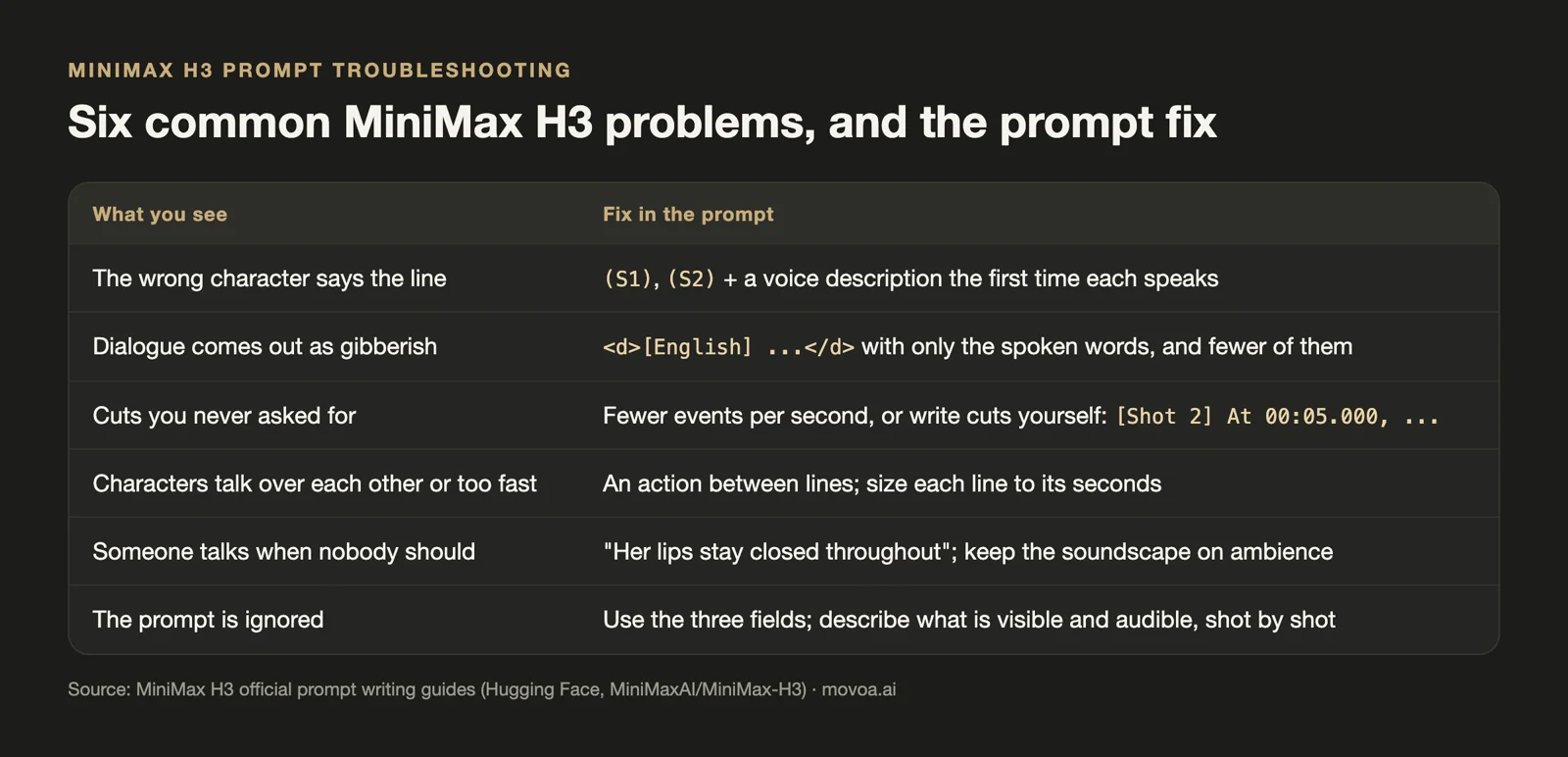
The first five rows are the complaints listed in the most-shared Reddit thread on the official guide; the sixth comes from a thread of daily H3 users.
| What you see | Fix in the MiniMax H3 prompt |
|---|---|
| The wrong character says the line | (S1), (S2) plus a voice the first time each speaks |
| Dialogue comes out as gibberish | Only spoken words in <d>[English] ...</d>, and fewer of them |
| Cuts you never asked for | Fewer events, or write the cuts with [Shot 2] At ... |
| Characters talk over each other or too fast | An action between lines, each sized to its time |
| Someone talks when nobody should | "His lips stay closed" |
| The prompt is ignored | The three fields, shot by shot |
FAQ
Does a MiniMax H3 prompt have to use the three-field format?
No, but MiniMax's own service rewrites plain sentences into this format before generating. Where nothing rewrites your text, as on Movoa, writing the fields yourself gets closest to the official results.
How long should a MiniMax H3 prompt be?
Long enough to cover every second: one shot and a line of sound for 4 seconds, 350 to 500 words in full reference mode. Movoa accepts up to 7,000 characters.
Can a MiniMax H3 prompt include dialogue in other languages?
Yes. Tag the language, such as <d>[Japanese] ...</d>, and keep the words as spoken. The rest stays in English.
How long can a MiniMax H3 video be?
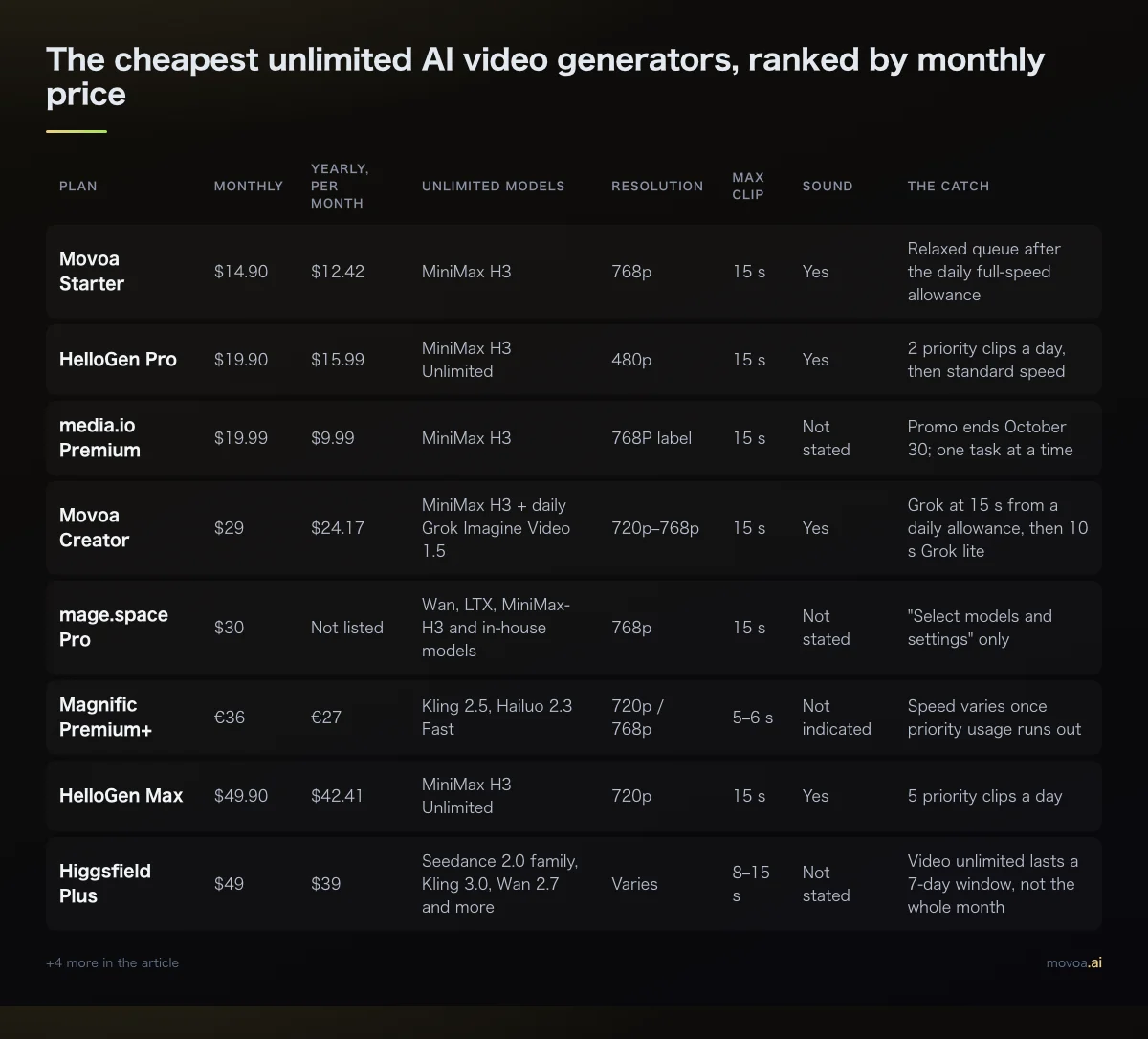
MiniMax H3 generates 4 to 15 seconds. On Movoa, free clips are 4 seconds at 480p with no daily cap, one at a time in a shared queue; paid plans from $14.90 a month add up to 15 seconds and 768p.
Pick a prompt above and open its run link: your first 4-second H3 clip with sound needs no sign-up. When the same prompt needs 15 seconds and 768p, Movoa's plans start at $14.90 a month.